 Wasatch
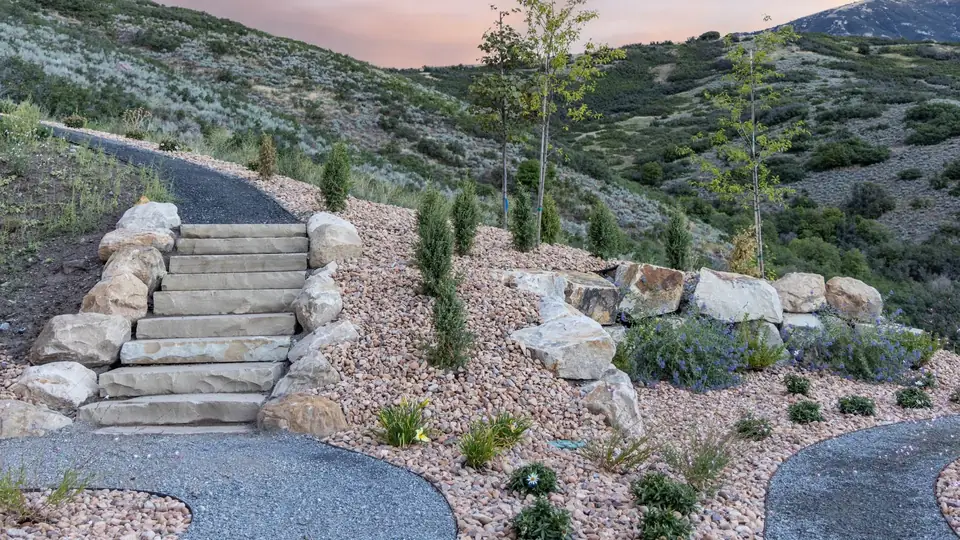
Water-wise does not mean zero-scape. The approach most Utah water districts promote, Localscapes, keeps a purposeful, useful lawn where you actually play, surrounds it with planting beds on drip irrigation, and connects the spaces with paths and gathering areas. You keep the green where it earns its water and stop watering park strips and side yards nobody walks on.
Choose "Water-wise / turf conversion" and the desert or xeriscape style in the design brief and a licensed local pro will come prepared to talk rebates as well as design.
Planning one? In the design brief, tick Planting Beds under “Which Features Do You Want?” and it reaches the pro with your style, size and budget.
Start Your Design BriefUtah's Lawn Replacement Rebates
The statewide Landscape Incentive Program, run through Utah Water Savers (utahwatersavers.com) with the Utah Division of Water Resources and local water conservancy districts, pays homeowners to replace existing lawn with water-efficient landscaping. Since launching statewide in 2023 the advertised amount has been up to $3 per square foot, varying by water provider; public coverage has cited around $2 per square foot through the state route and different figures for individual districts. Rates and rules change, so treat these as orientation and check the program site for your address.
Eligibility generally depends on your city having adopted the state's water-efficiency standards, projects have a minimum size (public coverage cites 200 square feet) and a per-property cap, and you typically must apply and be approved before you remove any grass. Jordan Valley Water Conservancy District, which serves much of the south Salt Lake Valley, began the program in 2017; Central Utah Water Conservancy District participates for Utah County. A separate Flip Your Strip option targets park strips.
- Apply first, get pre-approval, then remove the lawn. Removing grass before approval can forfeit the rebate.
- Keep before photos and invoices; programs ask for them.
- Converted areas usually need drip irrigation and plant coverage rules met at inspection (Utah Water Savers requires 50% perennial plant cover).
- Artificial turf is not paid by Utah Water Savers or Central Utah's programs. A rebated conversion is plants, drip and mulch or rock.
What a Conversion Costs
Modelled 2026 ranges. On a 1,000 square foot conversion that is roughly $8,000 – $18,000 before incentives, and a rebate at the published maximum rate would cover a meaningful share of it. Your district's actual rate decides how much.
| Item | Modelled cost | Notes |
|---|---|---|
| Lawn removal and grading | $1.50 – $3.50 per sq ft | Sod cut, haul-off, soil prep |
| Drip irrigation conversion | $1.50 – $3.00 per sq ft | Converts spray zones to drip, new valves if needed |
| Plants, mulch or rock, edging | $4 – $12 per sq ft | Depends on plant size and density, rock type and boulders |
| Typical full conversion | $8 – $18 per sq ft | Before any rebate |
Plants That Do Well Here
Utah County and the south Salt Lake Valley sit around 4,300 to 5,000 feet with hot, dry summers, cold winters and alkaline soil. Plants that thrive with little water include penstemon, blue grama and other native grasses, Russian sage, lavender, yarrow, agastache, catmint, blue mist spirea, and shrubs like serviceberry and mountain mahogany. Utah State University Extension publishes water-wise plant lists by region and is the best free reference.
The look is up to you. A desert style leans on boulders, gravel mulch, yucca and agave relatives; a mountain style uses flagstone, native grasses and conifers; a modern style uses gravel, clean steel edging and a restrained palette of ornamental grasses. All three can qualify as water-wise.
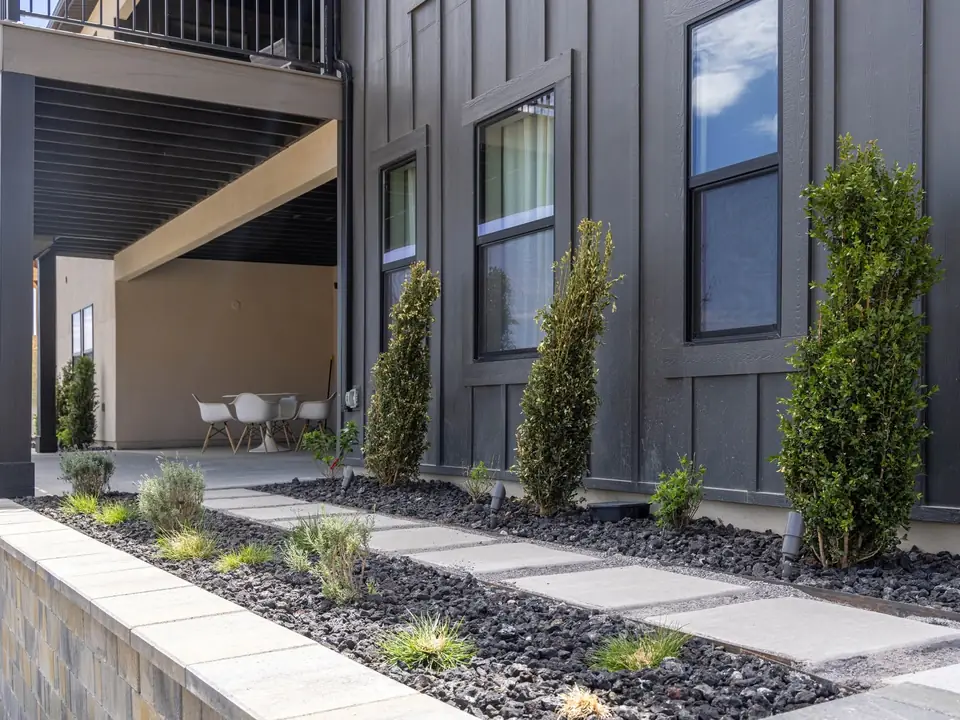 Project by the Utah landscape pro we refer
Xeriscape Plants for Utah Yards
A starting list of xeriscape plants that suit the Wasatch Front: hot, dry summers, cold winters, alkaline soil and 4,300 to 5,000 feet of elevation. "Native" here means native to Utah or the Intermountain West. Every plant on it, native or not, needs regular water for its first season or two while the roots establish, then far less.
| Plant | Type | Why it works here |
|---|---|---|
| Firecracker penstemon (Penstemon eatonii) | Native perennial | Red spring flowers, loved by hummingbirds, thrives in lean, dry soil |
| Rocky Mountain penstemon (Penstemon strictus) | Native perennial | Blue-purple spikes in early summer; one of the easiest native perennials |
| Sulphur-flower buckwheat (Eriogonum umbellatum) | Native perennial | Low mounds with yellow flowers; good on dry slopes and along rock |
| Yarrow (Achillea millefolium) | Native perennial | Flat flower heads all summer; tolerates heat and poor soil |
| Blue grama (Bouteloua gracilis) | Native grass | Fine-textured grass with eyelash seed heads; an accent or low-water meadow |
| Russian sage | Perennial (non-native) | Silver foliage and long lavender bloom; very drought tolerant once established |
| Lavender and catmint (Nepeta) | Perennials (non-native) | Long bloom, deer usually leave them alone, need good drainage |
| Blue mist spirea (Caryopteris) | Shrub (non-native) | Late-summer blue flowers when little else blooms |
| Utah serviceberry (Amelanchier utahensis) | Native shrub | Spring flowers, summer berries for birds, fall colour |
| Curl-leaf mountain mahogany (Cercocarpus ledifolius) | Native evergreen shrub | Year-round structure and screening on dry, rocky ground |
| Rubber rabbitbrush (Ericameria nauseosa) | Native shrub | Gold autumn flowers and silver stems; very low water |
| Gambel oak (Quercus gambelii) | Native small tree | The foothill oak of the Wasatch; shade and wildlife value with little water |
Planting a Xeriscape That Lasts
The plant list is the easy part. Whether a xeriscape still looks good in year five comes down to grouping, mulch and choosing for your exact spot.
- Group plants by water need on their own drip zones (hydrozoning, below) so the penstemon is not watered like the lawn.
- Mulch beds with rock or bark to cut evaporation; the Utah Water Savers rebate also has plant-cover rules, so check them before you plant.
- Park City and Heber are colder and shorter-season; ask for plants rated for your ZIP's hardiness zone.
- Utah State University Extension and the Localscapes program both publish free regional plant lists worth checking against this one.
Drip Irrigation, Zone by Zone
Most of the water a converted yard saves comes from the irrigation, not the plants. Spray heads throw water into the air, across sidewalks and onto mulch; drip puts it at the root zone through emitters rated in gallons per hour. The design step that makes this work is hydrozoning: grouping plants by how much water they need and giving each group its own valve, so the lavender is not watered on the lawn's schedule.
A good conversion keeps any lawn on its own spray or rotor zone, moves beds to drip with an emitter at each plant, and gives trees a separate ring of emitters that can be run longer and less often as they grow. Drip zones need a filter and a pressure regulator at the valve, and on secondary water a filter matters even more because the water carries silt. Expect to add or move emitters in the first two seasons as plants fill in.
- Ask how many zones the plan has and which plants share each one
- Ask for a filter and pressure regulator on every drip zone
- Ask how the system is winterised: drip lines and the backflow device must be drained before the first hard freeze
Secondary Water and Metering
Many Utah County cities, including Lehi, American Fork, Highland, Saratoga Springs and Eagle Mountain, irrigate with pressurized secondary water rather than drinking water, and state law now requires secondary connections to be metered by 2030. Once your outdoor water is metered, the savings from a water-wise yard show up directly on the bill.
Water-Wise Landscaping & Xeriscape — Questions Utah County Homeowners Ask
What can replace the lawn in a Utah front yard?
Layered drip-irrigated beds, a framed lawn panel, gravel and boulders, and compliant park-strip planting. See [front yard landscaping ideas for Utah](/guides/front-yard-landscaping-ideas-utah/).
What is Localscapes and where can I see rebates by city?
Localscapes is a Utah design method that keeps one purposeful lawn and puts the rest on drip. [Localscapes and drought-tolerant landscaping in Utah](/guides/localscapes-utah-drought-tolerant-landscaping/) compares 2026 rebates by city and covers HOA law.
Can my HOA stop me from replacing my lawn in Utah?
Not for a detached dwelling. Utah Code 57-8a-231 bars associations from prohibiting water wise landscaping, though they may require review. Details in our [Localscapes guide](/guides/localscapes-utah-drought-tolerant-landscaping/).
When is the best time to plant a water-wise yard in Utah?
Fall is a great time for trees, shrubs and perennials; spring works after the last frost. See the [season-by-season timeline](/guides/best-time-to-landscape-utah/).
Will a water-wise yard look like rocks and weeds?
Not if it is designed. Good water-wise yards are dense with plants on drip, keep a useful lawn where you play, and use rock as mulch rather than as the whole design.
How much is the Utah turf rebate?
Up to $3 per square foot has been advertised statewide since 2023, varying by water provider. Check utahwatersavers.com for your address and apply before removing any grass.
Can I keep some lawn?
Yes. The Localscapes approach most Utah districts promote keeps a central, usable lawn and converts the rest.
What are good xeriscape plants for Utah?
Natives such as firecracker and Rocky Mountain penstemon, sulphur-flower buckwheat, yarrow, blue grama, Utah serviceberry, mountain mahogany and rabbitbrush, plus proven non-natives like Russian sage, lavender, catmint and blue mist spirea. All need regular water for the first season or two.
Ready to plan your backyard?
Free estimates, no obligation. Call (385) 494-2758 or request a quote below.
Start Your Design BriefRelated Services
Patios & Pavers
Pavers, flagstone and concrete patios built on a base that survives Utah freeze-thaw.
Patios & Pavers →Retaining Walls
Block and boulder walls that turn a sloped Utah lot into usable flat space.
Retaining Walls →Outdoor Kitchens & Fire Features
Grill islands, full outdoor kitchens, gas fire pits and fire tables, planned for Utah winters.
Outdoor Kitchens & Fire Features →Landscape Lighting
Low-voltage LED lighting for paths, steps, walls, trees and the patio you just built.
Landscape Lighting →Pergolas & Shade Structures
Cedar, steel and louvered pergolas that shade a west-facing patio and stand up to canyon wind.
Pergolas & Shade Structures →Sports Courts
Pickleball, half-court basketball and multi-sport pads built level, drained and fenced for Utah winters.
Sports Courts →Putting Greens
Synthetic putting greens with real contours, built into the landscape rather than dropped on the lawn.
Putting Greens →Water Features
Fountains, pondless waterfalls and spillway walls planned for Utah winters and dry summer air.
Water Features →How Wasatch Landscape Studio Works
We are a referral service, not a landscaping company. Your design brief goes to one independent, Utah-licensed design-build contractor serving your area, and the referral never costs you anything. See how we vet our pros for the bar that contractor has to clear, read about us and what we will not do, or check the answers to common backyard questions. For anything else, contact us.
Water-Wise Landscaping & Xeriscape across the Utah County area
We serve Utah County and the surrounding Wasatch Front. Water-Wise Landscaping & Xeriscape is available in:
- Landscape Design in Lehi, UT
- Landscape Design in Highland & Cedar Hills, UT
- Landscape Design in Alpine, UT
- Landscape Design in American Fork, UT
- Landscape Design in Pleasant Grove & Lindon, UT
- Landscape Design in Saratoga Springs, UT
- Landscape Design in Eagle Mountain, UT
- Landscape Design in Orem, UT
- Landscape Design in Provo, UT
- Landscape Design in Springville, UT
- Landscape Design in Mapleton, UT
- Landscape Design in Spanish Fork, UT
- Landscape Design in Salem & Woodland Hills, UT
- Landscape Design in Elk Ridge, UT
- Landscape Design in Payson & Santaquin, UT
- Landscape Design in Sandy, UT
- Landscape Design in Draper, UT
- Landscape Design in Bluffdale, UT
- Landscape Design in Herriman, UT
- Landscape Design in Riverton, UT
- Landscape Design in South Jordan & West Jordan, UT
- Landscape Design in West Valley City, UT
- Landscape Design in Park City, UT
- Landscape Design in Heber & Midway, UT
- Landscape Design in Salt Lake City East Bench, UT
- Landscape Design in Holladay & Cottonwood Heights, UT
- Landscape Design in Millcreek, UT
- Landscape Design in Bountiful, UT
- Landscape Design in Centerville, UT
- Landscape Design in North Salt Lake, UT
- Landscape Design in Farmington, UT
- Landscape Design in Fruit Heights, UT
- Landscape Design in Kaysville and Layton, UT
- Landscape Design in Syracuse, UT
- Landscape Design in North Ogden and Pleasant View, UT
- Landscape Design in Ogden's East Bench, UT
- Landscape Design in Ogden Valley, UT
- Landscape Design in Vineyard, UT
- Landscape Design in Kamas, UT
- Landscape Design in Oakley, UT
- Landscape Design in Murray, UT
- Landscape Design in Taylorsville, UT
- Landscape Design in Ogden, UT
- Landscape Design in Roy, UT
Utah County landscaping cost guide: patios, walls, kitchens and more →