 Wasatch
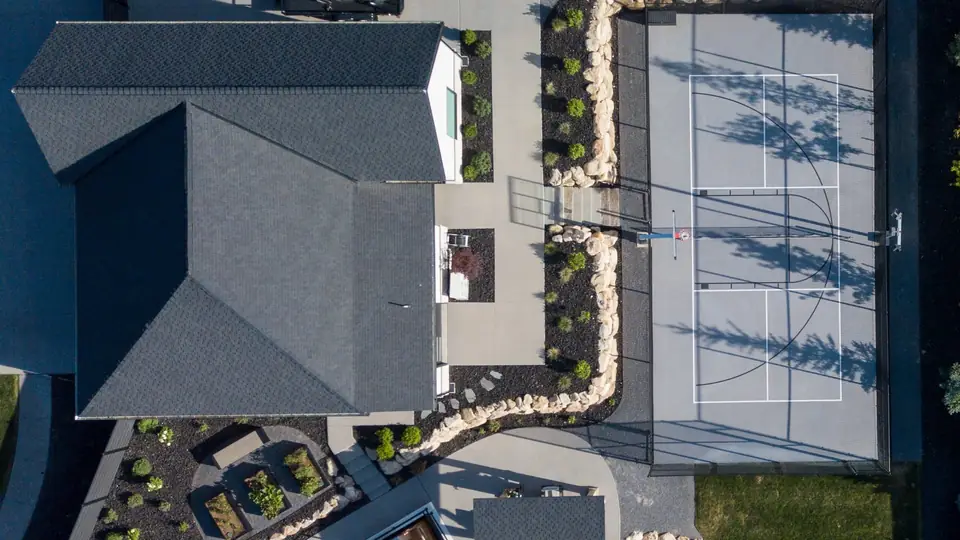
Pickleball has made the backyard court a common request on the Wasatch Front, alongside the half-court basketball pad that has always been popular with families on big new-build lots in Saratoga Springs, Eagle Mountain, Herriman and Lehi. Both are really the same project: a reinforced concrete slab, laid to a precise slope, finished with a sport surface, and surrounded by enough room and fencing to play without chasing every ball.
The decisions that matter are size, surface and containment, and the one most often underestimated is space outside the lines. Use the design brief to tell a licensed local design-build pro which games you play, and use this page to know what a sound bid includes.
Planning one? In the design brief, tick Sport Court or Putting Green under “Which Features Do You Want?” and it reaches the pro with your style, size and budget.
Start Your Design BriefHow Much Room Each Game Needs
A regulation pickleball court is 20 by 44 feet, but the pad it sits on should be about 30 by 60 feet so players can move behind the baseline and beside the sidelines; USA Pickleball's recommended total area is larger still for competitive play. A backyard half court for basketball is commonly 30 by 30 feet, and a 20 by 20 foot shooting pad covers free throws and games of horse. A full-size tennis court needs roughly 60 by 120 feet, which few residential lots can spare.
Multi-sport courts paint or tile lines for two or three games on one pad. A 30 by 60 foot pad can carry pickleball lines and a hoop at one end, which is often the best value for families with mixed ages.
What a Backyard Court Costs
Modelled 2026 ranges from national cost guides adjusted for Wasatch Front labour; they are orientation, not quotes. Grading is the big swing factor: a court on a sloped bench lot in Alpine, Highland or Draper may need a retaining wall on the low side before any concrete is poured.
| Build | Modelled installed cost | Typically includes |
|---|---|---|
| Shooting pad, about 20 × 20 ft | $8,000 – $16,000 | Slab, tiles or coating, in-ground hoop |
| Half court, about 30 × 30 ft | $15,000 – $32,000 | Slab, court tiles, lines, adjustable in-ground hoop |
| Pickleball pad, about 30 × 60 ft | $30,000 – $60,000 | Slab, surface, lines, net posts; fencing extra |
| Court fencing or ball netting, 10 ft | $50 – $110 per linear ft | Black vinyl chain link or netting on steel posts |
| LED court lighting | $5,000 – $15,000 | Two to four poles, shielded fixtures, electrical permit |
The Slab Under the Surface
Utah's freeze-thaw cycles find every weakness in a large slab. A typical residential court is a 4 inch reinforced concrete slab on 4 to 6 inches of compacted road base, pitched in a single plane at about 1 percent (roughly an eighth of an inch per foot) so water sheets off one side instead of ponding. On the clay valley soils of Lehi, Saratoga Springs and Herriman, the base and drainage deserve as much attention as they do under a patio.
Two surfaces dominate. Snap-together polypropylene court tiles float over the slab, drain through, soften falls and hide minor hairline cracks, which suits Utah winters. Acrylic coatings give a smooth, tournament-style surface but show any crack in the slab beneath and need resurfacing every several years. Ask which surface the bid assumes and how cracks are handled.
- Ask for the slab thickness, reinforcement and control-joint plan
- Ask which way the court drains and where that water ends up
- Ask how deep the hoop and fence post footings go; frost and wind loads decide it
Fencing, Noise, Light and Neighbours
Balls leave courts. A 10 foot fence or ball-stop netting along the ends is common, but many Wasatch Front cities cap rear-yard fences around 6 feet without a permit or special approval, so a taller enclosure is a question for the city and the HOA before it goes in the design. Pickleball also carries: the hard paddle sound travels further than a basketball bounce, so placing the court away from bedroom windows next door is a design decision, not an afterthought.
Court lighting extends play into the evening but needs an electrical permit, shielded fixtures aimed down at the court, and an eye on any city or HOA rules on light trespass and hours. Warm, cut-off fixtures are kinder to neighbours and to the night sky.
Permits, HOAs and Drainage Rules
A ground-level slab often needs no building permit in Utah County cities, but fences over the local height limit, retaining walls over about 4 feet, lighting circuits and any change that sends more water toward a neighbour can. A large new hard surface adds runoff, and city codes expect it to be handled on your own lot, so the drainage plan matters to the inspector as well as to the court.
Many neighbourhoods in Daybreak, Lehi, Saratoga Springs and Herriman have HOA architectural review that covers courts, fences and lighting, and approval can take several weeks. Before any digging, Blue Stakes of Utah (811) marks public utilities; private sprinkler and secondary water lines need to be located separately.
Sports Courts — Questions Utah County Homeowners Ask
How big should a backyard pickleball court be?
The court itself is 20 by 44 feet. Plan a pad of about 30 by 60 feet so players have room behind the baselines and beside the sidelines.
Are court tiles or a painted surface better in Utah?
Tiles drain, cushion and ride over minor slab cracks, which suits freeze-thaw. Acrylic coatings feel smoother but show cracks and need periodic resurfacing. Both need a sound, sloped slab.
Do I need a permit for a sport court?
Often not for the slab alone, but tall fencing, lighting, retaining walls and drainage changes commonly do, and most HOAs review courts. Your city decides.
Ready to plan your backyard?
Free estimates, no obligation. Call (385) 494-2758 or request a quote below.
Start Your Design BriefRelated Services
Patios & Pavers
Pavers, flagstone and concrete patios built on a base that survives Utah freeze-thaw.
Patios & Pavers →Retaining Walls
Block and boulder walls that turn a sloped Utah lot into usable flat space.
Retaining Walls →Outdoor Kitchens & Fire Features
Grill islands, full outdoor kitchens, gas fire pits and fire tables, planned for Utah winters.
Outdoor Kitchens & Fire Features →Water-Wise Landscaping & Xeriscape
Lawn conversion, xeriscape and Localscapes-style yards, plus how Utah's turf rebates work.
Water-Wise Landscaping & Xeriscape →Landscape Lighting
Low-voltage LED lighting for paths, steps, walls, trees and the patio you just built.
Landscape Lighting →Pergolas & Shade Structures
Cedar, steel and louvered pergolas that shade a west-facing patio and stand up to canyon wind.
Pergolas & Shade Structures →Putting Greens
Synthetic putting greens with real contours, built into the landscape rather than dropped on the lawn.
Putting Greens →Water Features
Fountains, pondless waterfalls and spillway walls planned for Utah winters and dry summer air.
Water Features →How Wasatch Landscape Studio Works
We are a referral service, not a landscaping company. Your design brief goes to one independent, Utah-licensed design-build contractor serving your area, and the referral never costs you anything. See how we vet our pros for the bar that contractor has to clear, read about us and what we will not do, or check the answers to common backyard questions. For anything else, contact us.
Sports Courts across the Utah County area
We serve Utah County and the surrounding Wasatch Front. Sports Courts is available in:
- Landscape Design in Lehi, UT
- Landscape Design in Highland & Cedar Hills, UT
- Landscape Design in Alpine, UT
- Landscape Design in American Fork, UT
- Landscape Design in Pleasant Grove & Lindon, UT
- Landscape Design in Saratoga Springs, UT
- Landscape Design in Eagle Mountain, UT
- Landscape Design in Orem, UT
- Landscape Design in Provo, UT
- Landscape Design in Springville, UT
- Landscape Design in Mapleton, UT
- Landscape Design in Spanish Fork, UT
- Landscape Design in Salem & Woodland Hills, UT
- Landscape Design in Elk Ridge, UT
- Landscape Design in Payson & Santaquin, UT
- Landscape Design in Sandy, UT
- Landscape Design in Draper, UT
- Landscape Design in Bluffdale, UT
- Landscape Design in Herriman, UT
- Landscape Design in Riverton, UT
- Landscape Design in South Jordan & West Jordan, UT
- Landscape Design in West Valley City, UT
- Landscape Design in Park City, UT
- Landscape Design in Heber & Midway, UT
- Landscape Design in Salt Lake City East Bench, UT
- Landscape Design in Holladay & Cottonwood Heights, UT
- Landscape Design in Millcreek, UT
- Landscape Design in Bountiful, UT
- Landscape Design in Centerville, UT
- Landscape Design in North Salt Lake, UT
- Landscape Design in Farmington, UT
- Landscape Design in Fruit Heights, UT
- Landscape Design in Kaysville and Layton, UT
- Landscape Design in Syracuse, UT
- Landscape Design in North Ogden and Pleasant View, UT
- Landscape Design in Ogden's East Bench, UT
- Landscape Design in Ogden Valley, UT
- Landscape Design in Vineyard, UT
- Landscape Design in Kamas, UT
- Landscape Design in Oakley, UT
- Landscape Design in Murray, UT
- Landscape Design in Taylorsville, UT
- Landscape Design in Ogden, UT
- Landscape Design in Roy, UT
Utah County landscaping cost guide: patios, walls, kitchens and more →